Wednesday, 7 April 2010

Putting some spice into the marriage

We celebrated our 28th wedding anniversary a few days ago by going to our favourite curry house, the Ali Tandoori, in Norwich.


Their chicken chat (starter) is the best I've tasted anywhere, and the rest of the food is excellent too.

One of the waiters took a photo of us after the meal.


Alan of nb Lazy Days says he had a good takeaway from the Indian Ocean in Nantwich recently. I'm glad it worked out; there's always a risk when recommending an eatery that it just won't be so good for someone else.

I'll see if I can put a Google Street view image of the Indian Ocean here:


View Larger Map

Wow! Yes, I can! So that's how you do it. (Click on the left or right arrow in the circle in the top left of the picture if you can't see the Indian Ocean.) And I'm told that Street view now covers something like 99% of the country. Can that be true?

And has anyone tried wearing 3-D glasses (red/green) to view street view in 3-D?

Tuesday, 6 April 2010

So this is what the bed of an iron trunk aqueduct looks like

Just round the bend from Wigwell Aqueduct on the Cromford Canal is the iron trunk aqueduct over the railway, just as it enters/leaves Leawood Tunnel.


A notice by the aqueduct explained why it was drained: apparently it was found to be weak, so the lack of water relieves some weight. The towpath is taken over a temporary scaffolding-and-plank structure. I'm not sure how that helps, though, as it appears to be resting on the aqueduct.


Isn't draining an iron trunk aqueduct almost the worst thing you can do? Look at the rust starting to eat away at the side. Under water, as long as there's no oxygen, rust cannot form. How much longer will this survive?


As Captain Ahab notes in his UK aqueducts list the plughole is impressive.


I had imagined the bed of an iron trunk to be perfectly smooth. Are the ribs for strength, or is that just the way the trunk is assembled?

Monday, 5 April 2010

This towpath is a horse free zone


Is it because the aqueduct wouldn't take the extra weight? Unlikely.

Would the horse's hooves damage the nice flat surface? Possibly, but I don't think that's the reason either.

No, I think it's because the far (south east) end is stanked off, reducing the canal to a weedy ditch.


This is the Cromford Canal's Leawood Wigwell Aqueduct over the River Derwent just south of High Peak Junction, a mile south of Cromford. (Captain Ahab calls it the Wigwell Aqueduct, and has a virtually identical photo here.)


I talked about horse drawn trip boats recently, but missed this one. Apparently the Horseboating Society tows narrowboat Duchess on demonstration trips (no passengers) between Cromford Wharf and the aqueduct on heritage days, presumably coinciding with steaming of the Leawood Pumping Engine. In the 1980s the then Cromford Canal Society ran passenger horse drawn trips, but these didn't last.

Back to the top photo: the sign actually appears to prohibit horses from leaping over the wall. But, assuming it refers to the towpath, if you were leading a horse from either direction you wouldn't know where the prohibited zone was.

Sunday, 4 April 2010

High Peak Junction

We saved up the Cromford Canal for the last day of our little holiday. To get there we parked to the south of the town, walked to the line of the Cromford and High Peak Railway, and then along and down Sheep Pasture incline (1 in 8) to High Peak Junction. (I'll post about the C&HPR later.) Here the railway met the canal.


The above photo shows a bit of the canal, with the railway workshops behind, and two brown brake vans at the foot of the incline.


A few yards downstream stands a warehouse with covered loading bay. The warehouse is used today by a community group - that's presumably their narrowboat tied up outside.


The white post would have supported a crane. One railway track led right inside the warehouse: the sign above the door reads "ENGINE MUST NOT ENTER THIS WAREHOUSE" (I assume an "S" has fallen off), so wagons would have been shunted under cover for loading/unloading.

Top Thirty, 2010 week 13

Here is the UK Waterways Site Ranking as it stood at 2030 on Sunday 4th April 2010. This is taken, with permission, from Tony Blews's UK Waterways Ranking Site.


1 Jim Shead's Waterways Information (=)

2 Pennine Waterways (+1)

3 JustCanals.com - Forums (-1)

4 CanalPlanAC (+1)

5 Granny Buttons (-1)

6 CanalCuttings.co.uk (=)

7 Retirement with No Problem (=)

8 Narrowboat Gypsy Rover (+1)

9 Towpath Treks (-1)

10 Jannock Website (=)

11 UKCanals Network (=)

12 Trafalgar Marine Services (+2)

13 Narrowboat.co.uk (+6)

14 Google Earth Canal Maps (+4)

15 Waterway Routes (=)

16 Water Explorer (-3)

17 nb Epiphany (-1)

18 Canal Photos (-6)

19 Narrowboat Bones (+1)

20 WB Takey Tezey (+3)

21 nb Lucky Duck (=)

22 Chertsey (+3)

23 Derwent6 (+1)

24 Narrowboat Caxton (-2)

25 Working Boat Hadar (+1)

26 Baddie the Pirate (-9)

27 Captain Ahab's Watery Tales (+1)

28 Zulu Warrior (-)

29 Contented Souls (-)

30 nb Piston Broke (-1)

The figures in parentheses denote the number of places moved since the previous chart; (-) denotes new entry or re-entry into the top thirty; (=) denotes no change.
Halfie is at number 32. There are 104 entries altogether.

Saturday, 3 April 2010

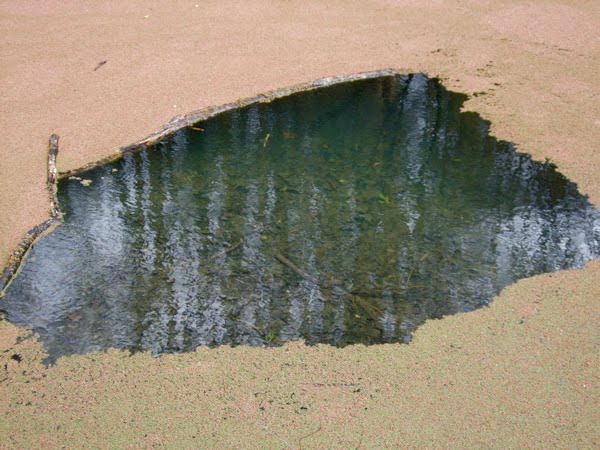
Red duckweed


Until walking along the Cromford Canal I'd thought that duckweed could be only one colour, i.e. green. But here it was red! The photos don't do it justice: it looked a lot redder than this, like a freshly laid cycle lane (a red one, obviously). The duckweed had collected between two narrows, just in this section between High Peak Junction and Whatstandwell.


Its scientific name appears to be Lemna turionifera and, according to the Joint Nature Conservation Committee it was first recorded in the wild in England in 2007. The National Biodiversity Network forum gives this additional information:

A new species of Duckweed (Lemna) was discovered in the wild in Britain during 2007 - this is the Red Duckweed (Red Duckweed (Lemna turionifolia Landolt). It was discovered at two separate sites. 

It is described in the most recent edition of Watsonia (Vol 27, Part 2) and was an article published by R. Lansdown. In brief, Lansdown states that Red Duckweed was discovered in Dorset in May 2007 then Lincolnshire in July of the same year. It is a native of North America (yet another botanical species to become established from those shores) and northern Asia. Lansdown suggests that this species is overlooked in Britain. 


A couple of branches made this "hole" in the duckweed: you can see that the bottom of the canal here is very close to the top.

This is the more usual colour of duckweed, seen here on the Shroppie near Ellesmere Port in 2005.


The close-up photo looks like a colour blindness test, doesn't it?

Friday, 2 April 2010

Animals


Animals were what boatmen used to call the donkeys which hauled their boats. This post is not about donkeys.

Picture of factories with tall chimneys  pouring out black smoke.

Animals is the name of a Pink Floyd album from the late 1970s. You know, the one with the pig flying over Battersea Power Station. This post is not about Pink Floyd.


On our recent holiday in Derbyshire's Peak District we saw lots of animal life. This post is about that.

Near Bakewell we walked past kennels. These kennels have been here a long time: they're marked on my 1967 OS One inch map of Buxton and Matlock - the map I used when youth hostelling in this area in 1973.


Our footpaths took us past more cows still in their shed, munching on winter feed. The herdsmen have been waiting for the grass to grow sufficiently after the hard winter before letting them out.


The River Lathkill was, apparently, cited by Isaak Walton (The Compleat Angler) as having some of the purest waters in the land. This fish was about a foot long.


A little further up the Lathkill, in the amazing turquoise water I watched as a duck got a bit near the weir.


A moment later:


That'll do for now. Posts on the Cromford Canal coming up.

Top two photos from Wikipedia

Thursday, 1 April 2010

Watch that kettle, it might not boil

When we arrived at the cottage in Bakewell at 3.00pm the first thing to do after unloading the car was, of course, to make some tea. Having filled the kettle I put it on the ring and lit it.


After several seconds I became aware of a smell of burning paper. Oh, there's a bit of something stuck to the bottom of the kettle, I thought. As I lifted it off the flame the burning paper smell was overtaken by a much stronger burning plastic smell. On inspecting the underside of the kettle everything suddenly became very clear.


Yes, the kettle which looked exactly like the one we use on the gas hob on Shadow was actually an electric kettle. And I'd lifted it off its base to fill it. My excuses are that at home we have an older-style jug kettle which has a lead plugged into it; and that the one in the cottage was designed to look just like a hob kettle. I mean, how ridiculous is that? It's inviting disaster. A wireless kettle, indeed!

Importantly, we did get that cup of tea. By holding the kettle down on its base I got it to make a connection.

We owned up to the, er, owners, and bought a replacement. All ready for the next occupants to destroy.

(that's the new kettle on the hob for illustrative purposes; the underneath shot is the real thing)

OK, I've confessed to a senior moment.  Now it's your turn.