Showing posts with label Middle Level. Show all posts

Friday, 31 August 2018

Steam trains, boats, planes and parachutes

Not such an exciting day as yesterday: the anchor stayed unused (but ready if needed). We had another early-ish start and kept going until (almost) sunset.

We left March at 0820 and continued along the old course of the River Nene. At Floods Ferry the old course of the Nene bears left; we took Whittlesey Dyke to the right.

nb Salar was leaving Ashline Lock as we approached; they opened a paddle for us while we were securing the boat to the lock landing. nb Annie and Walt were behind us; they also helped and we were soon under way to our 1430 appointment at Stanground Lock. We were ahead of schedule, actually arriving almost an hour early. I had been expecting to have to wait on the lock landing but the lock keeper waved us in. Everyone had been early, she said, and she was looking forward to being able to run some more water into Whittlesey Dyke to keep the level up. She must have been doing that before we got there as our speed had been dropping with the flow against us.

We stopped at Peterborough to fill and empty, and decided to carry on another three hours or so as we had time in hand.

Today was not without interest. As we left Peterborough we heard a steam train whistle; at Orton Lock we glimpsed the source of the evocative sound travelling along the Nene Valley Railway.

That's the Union of South Africa loco behind the wooden buildings.

At Water Newton Lock Jan pointed out some objects in the sky. They probably look like dirt on my camera lens - or on your computer screen - but those specks on my photo are what I'm talking about.

Parachutists, at least eight of them, were spiralling slowly to the ground behind the trees.

Some were tandem jumps.

When I turned back to look at the lock the low sun was making the scene very picturesque.

At the end of today's journey we tied up alongside another boat at Wansford Station, where steam trains were running until after dark. This was an excellent spot for watching the train passing over the bridge above us.

My camera and I were struggling to take decent pictures in the gloom. I'll leave you with this shot of the train at night running towards Peterborough.

Tomorrow looks like being another long day: we're aiming for Oundle.

Thursday, 30 August 2018

We had to drop our anchor ...

… and it did NOT hold.  But I'll start at the beginning of this exciting day.

My alarm went off at 0459 so I would be sure of a 0600 getaway.  This was the time suggested by others in our little convoy; I had wanted a later start so we would meet the tide further up the river, but I went along with the prevailing opinion.  It later transpired that the later start might have been better, but that's water under the bridge (literally).

At 0620 we passed under the road bridge marking the start of the New Bedford River or One Hundred Foot Drain.

There were six boats in our convoy: two in front ...


and three behind.

Everything was going well. I had cranked up our revs to about 1400 rpm (300 more than our usual cruising speed) and we were making about 5 mph.

Until, that is, we entered a narrow section.

Our speed reduced and the boats were churning up the mud. The engine must have been labouring because the over-temperature alarm went off. We reduced speed and opened the hot taps to drain off some of the heat. After a couple of minutes the alarm stopped and we gingerly increased speed again. This happened two or three times.

Around the same time we met the incoming tide, bringing with it lots of weed.

Our speed dropped even more until we stopped making any forward progress.

When we started going backwards we struggled against the tide for five minutes before I decided it would be sensible to drop the anchor so we would stop going backwards. We could also cut the engine and let it cool down.

So I lowered the anchor over the side and into the water. This was the first time it would be tested. As soon as the anchor touched the bottom it pulled hard on the chain and the warp (the nylon rope) connected to it. I was not expecting the force of the pull; consequently the warp tangled and formed a knot shortening it by a few feet. The end was (of course) already attached to the T stud on the boat, and everything immediately went taut.

What really surprised me was the realisation that the anchor - a really heavy one - was dragging along the bottom. Who knew? I thought the whole point of an anchor was to secure the boat in an emergency, but this was not working. It did, at least, considerably slow our backward progress, so we switched off the engine and suggested to Bob on Bimble, who was also going backwards, that he tie up to us. This he did, and he dropped his own anchor.

We were still going backwards but after a while we stopped moving. The anchors must have just been sliding along the mud until the flow lessened.  I estimate the flow was about 6 mph at its peak.

I made coffee and had a look down the weed hatch. There was a considerable amount of weed round the prop and the top of the rudder.

After about 45 minutes we thought we should try to get going again, so I pulled Bob, who was single handing, forward on his centre line so he could weigh his anchor. Then he was off.

We motored forward and I pulled up our anchor. It came up easily, which was a relief. Then we got under way and were surprised that we were very soon able to make 5 mph at about 1200 rpm. The tide had evidently turned quickly. I phoned the lock keeper at Salter's Lode again when we were approaching Denver (we had phoned him when we were stuck). We had seen Bimble ahead of us reverse onto the pontoon by Denver Lock; Paul at Salters Lode said we could come straight to his lock. So we kept going and turned into the lock entrance as a boat in front was just going into the lock.

I won't go into details about any perceived queue jumping. We continued on the Middle Level to March, where, at gone 1830, we tied up against a friendly hire boat.

The end of a long, interesting day!  Oh yes, if we'd left Earith later we would have met the tide when it had come further along the drain.  Then it would have had less effect and we might have been able to push against it.

Monday, 23 July 2018

WEED!

We were getting on so well, the Twenty Foot River and us. We'd successfully negotiated one of the lowest bridges on the Middle Levels. Nothing disturbed us at our wild mooring last night. We easily got back into the centre channel this morning … and then came the weed.

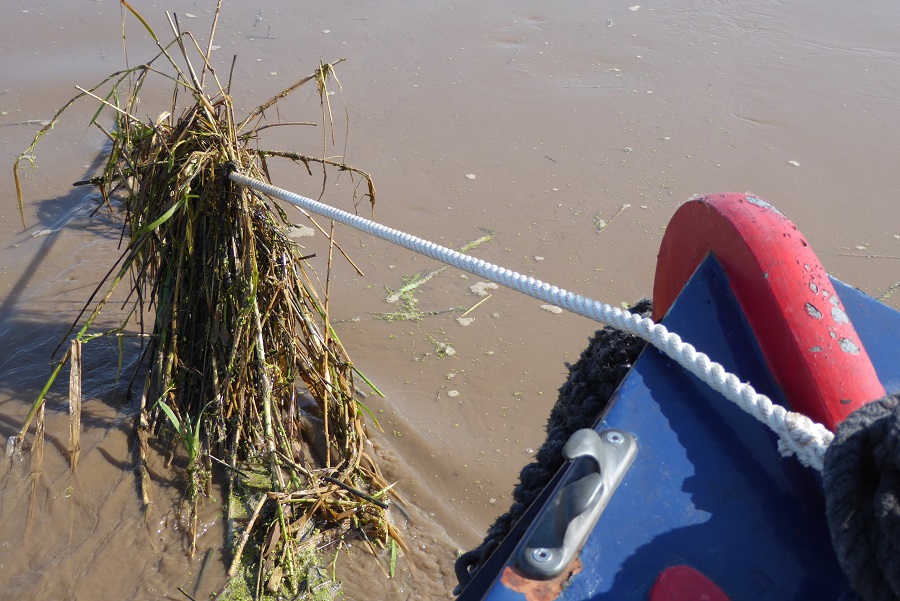
There was no escaping it. The vile stuff spread from one bank to the other and clogged the prop verty quickly. In the worst areas I was down the weed hatch every few yards. Progress, as can be imagined, was almost non-existent.

This is our lunch 'mooring': stuck in the middle of the waterway.

There was so much weed coming out of the hatch that I knew I was actually pulling it off the bottom of the river.

I had to resort to punting with the cabin shaft to try to reach some clearer water - it's not easy punting a narrowboat.

Eventually the visits down the weed hatch became less frequent and we reached the junction with the Old River Nene. I had originally wanted to explore down to Benwick and Ramsey, but our experience with the weed rather put us off that idea. We turned left towards Upwell and Outwell instead. Funnily enough, we hadn't seen a single boat since joining the Twenty Foot nearly 24 hours earlier. Even the outer reaches of the BCN have more boats.

The route to Three Holes via Popham's Eau looked clear, wide and inviting, but we chickened out and turned left here too. The signs erected by the Middle Level Commissioners have writing that's far too small for me to read.

Before getting to Marmont Priory Lock we rang the number as instructed and left a message. No-one got back to us. At the lock itself we rang the bell, again as requested, and worked ourselves through in the normal manner. Nothing seemed to require the attentions of a lockie, who didn't materialise.

Here's something I hadn't come across before: a receptacle for tips for the lock keeper.

Needless to say, I didn't add to the coins in the tin.

Very soon we arrived in Upwell and found ourselves in our home county of Norfolk.

We tied up on the first public mooring, March Bank, I think it was called, but I then cycled up to the Church Bridge mooring and saw that we would fit there, so I moved the boat up.

We visited our friend Sally in Outwell after tea.

Sunday, 22 July 2018

How to check a bridge clearance before getting there

We did lots of exciting new stuff today, including Stanground Lock, an unusual windlass, a little-used waterway and a low bridge. I have included rather a lot of photos, but bear with me.

Opposite our mooring on Peterborough Embankment was this splendid old warehouse, complete with integral loading bay.

We were booked into Stanground Lock at 0900, so at 0840 we set off down our last bit of the Nene and looked for the right turn leading to the lock.

This must be it … but why the no entry sign?

As we got nearer it became clear that the no entry sign merely warned off using the wrong arch, and there was a sign - quite small - indicating Stanground Lock.

After passing some waterside houses and a boatyard we soon came to Stanground Lock and were checked in by Ashley.

The bottom gates are hydraulically operated and we stayed on board while Ashley worked us through.

Now we were on Well Creek … and into fenland.

The tight bend at Whittlesey wasn't a problem, and we came to the visitor mooring just before Ashline Lock.

We tied up and walked across the recreation ground to St. Mary's Church for the 1100 service. We were only a few minutes late. Afterwards we looked round the small market town and had a roast lunch at the Sunshine Café. We probably won't eat there again.

There are some interesting buildings in Whittlesey, including the Butter Cross and this former town hall and fire station.

Back on the boat we waited while a boat on the lock landing entered the lock, then we went to the lock landing. After days of seeing few boats at the locks on the Nene this lock, Ashline, was busy. We witnessed two boats come up and three go down, including us.

This was where I could try out the special Middle Levels windlass which I had acquired from somewhere.

The paddles - here called penstocks - take a lot of winding. I counted at least 60 turns. And the lock is very slow to fill - no danger of buffeting a boat coming up.

Having talked to various boaters I decided we would try the Twenty Foot River route, but we needed to see if we could get under a low bridge. Tying up at the lock landing below Ashline Lock I used a long batten and a tape measure to calculate that our air draft was 1.86m. Oh dear. According to the Middle Level Navigation Notes which the Stanground lockie had given us (and which our friend Tony had printed off for us in Northampton) the maximum air draft at Infield's Bridge was 1.60m.

Then I had a brainwave. The air draft at Angle Corner Bridge is supposed to be 1.95m, so Infield's must be 35cm lower. All I had to do was measure how much headroom we had at Angle Corner. If it was at least 35cm then we would fit under Infield's. We had 42cm to spare under Angle Corner Bridge ...

so we continued along the wide, deep Twenty Foot.

Eventually the low bridge got close enough to photograph. Would my calculations be right?

Yes! I reckon we had a good 10cm in hand.

So why were both bridges higher than advertised? It must be because the 'book' measurements were taken at a much higher water level than we are experiencing. According to the Navigation Notes there are only two bridges lower then Infield's: Bradford Bridge on Yaxley Lode (1.56m) and Exhibition (Stokes) Bridge on the Old River Nene (1.53m). If the water levels stay as they are we should be able to pass under both of them.

We weren't going to make it to March before the F1 Grand Prix highlights so we tied up to the reedy bank in the middle of nowhere.

Tomorrow we intend to turn right onto the Old River Nene to go through March and on towards Ramsey.

Thursday, 28 April 2011

St. Germans Pumping Station

I was privileged recently to be at a brand new pumping station in the Fens for its official opening. I was there to make a report for BBC Look East.


A pumping station was built at Wiggenhall St. Germans in 1934 for pumping water from the Middle Level Main Drain into the River Great Ouse, and thence to the sea at King's Lynn. Prior to that time discharge by gravity to low tides was possible, but peat shrinkage was making the land sink, and modern building methods were leading to faster rainwater runoff into the drains which fed the Middle Level. Now, if it were not for the pumps at St. Germans, the Middle Level and its tributaries would flood, inundating 170,000 acres of land including the towns of Whittlesey, Chatteris, March and Ramsey. The land has sunk to the extent that even a low tide is higher than the normal Middle Level level. On the day I went, the difference in levels was about 3.4 metres - but the pumps were not on as there had been little rain for several weeks.

Now the time had come to replace the original pumping station, and work started on the new one in December 2006. In April 2010, over a four day period, the old pumps were switched off, and the new station became operational.

I was told why the official opening was a year later, but I can't remember the reason now. Possibly something to do with tidying the site.

Lord James Russell revealed the plaque and pressed a symbolic big green button. His ancestor, William Russell, was the Earl of Bedford. It was he who instigated the draining of the Fens in the 17th century - employing Cornelius Vermuyden - and thus created Britain's "breadbasket", the large area of highly productive arable land.

The tour of the pumping station was fascinating. There are six pumps, each driven by a 1.5 MW electric motor - yes, that's one and a half megawatts! Three pumps can run from the mains electricity, but if four or more pumps are required, diesel generators are used. Each pump has its own 1.7 MW generator, each with a 40,000 litre fuel tank. The engines are V12 units made by Finning. The pumps' impellers are 2.6 metres in diameter and weigh 5 tonnes, and rotate only about one and a half times a second.

When all six pumps are running the station can shift 100 tonnes of water every second - it could empty an Olympic size swimming pool in 25 seconds!

Just as the engineering is awesome, so the building itself is striking. In black, with a glass front, it is beautiful as well as being functional. In a remarkable way it seems to fit in to the surroundings.