Showing posts with label Montgomery Canal. Show all posts

Thursday, 14 July 2016

Water boatmen

At the bottom of Frankton Locks we waited for 1200 to come round. And we waited some more. No sign of CRT. At about 1300 the Aussie on the hire boat behind us found he had a signal and phoned CRT to see what was going on. There was some story of a "minor emergency" and a promise of action. At 1335 a lockie turned up and apologised for the late start. I think the person who should have been on duty hadn't been told - or something.

At 1345 we were able, at last, to ascend the locks.

While we were waiting I noticed a large number of water boatmen skating on the surface of the water. There were one or two damsel flies too, but I didn't even attempt a snap.

The lower chamber of the staircase pair is, for some reason, smaller than the upper one. This means that water has to be run down from the pound above to ensure that boats do not ground on the sill when moving from the lower chamber to the upper one.

Here is Jubilee in the lower chamber.

At the top we turned right and tied up in the Ellesmere Arm. We shopped at Tesco and went to the Red Lion for another good meal. Their chips are the best.

Wednesday, 13 July 2016

Exploring more of the Montgomery Canal

After a peaceful night at Maesbury Marsh we set off to go to the current limit of navigation, which we had heard was now extended a little beyond Gronwen Bridge 82.

We cruised in tickover through the bridge and entered new territory. The channel seemed deep and remarkably weed-free.

A lift bridge (unnumbered) was open ...

... and after considerably more "new" canal than I was expecting we arrived at the new limit at Redwith Bridge 83.

The string across the bridge hole wasn't the only thing preventing further progress; stop planks were installed so that the next section of canal could be lowered.

Immediately beyond the next bridge (84) the Shropshire Union Canal Society was working on replacing a collapsed culvert and putting in an offside mooring.

It was great to have covered a bit more of the network - I wasn't expecting to encounter any "new" bits this year. I am looking forward one day to being able to do the full Monty. To get back to the winding hole at Bridge 82 we had to reverse, of course. This went remarkably smoothly. Then we had lunch while at the services at Maesbury Marsh and returned to the bottom of Frankton Locks. It rained a bit on and off, but nothing too heavy.

As we approached Graham Palmer Lock Jan spotted that a kingfisher was perching on the bottom gate. Can you see it?

Here.

We had very little internet signal last night so this post is a bit late.

Tuesday, 12 July 2016

There's a lot of corrugated iron round here

We said goodbye to David this morning and then set off ourselves down Aston Locks. It started raining as we left the bottom lock; I had hoped to get to Maesbury Marsh for lunch but the rain just got heavier and heavier. There aren't many opportunities for mooring on the Monty so at the first bit of piling without too much foliage I pulled in and tied up. I was glad to get back inside the boat.

Notice anything about the picture of Jubilee where we stopped?

Yup. That's woodsmoke coming from the chimney. We have had the fire going every month since April.

When the rain stopped - at about 1545 - we carried on the half mile or so to Maesbury Marsh. After checking out the pub, the Navigation, we went for a bit of a walk. The horse-drawn trip boat building has a corrugated iron roof, so too do a few other places round here including St. John's Church, Maesbury.

Not only the roof - the walls as well!

We did a bit of planning this evening. From here we'll go back to Hurleston Junction, then head north on the Shroppie to Chester and Ellesmere Port, returning down the length of the Shroppie to Wolverhampton.

Monday, 11 July 2016

Goats in the churchyard

When the morning's rain had died down enough we set off for Frankton Junction, about a mile away. After lunch we were admitted to the locks and quickly descended the staircase pair and the other two, then turned into the Weston Branch to the services. I was surprised that the boats below the locks weren't allowed up before a couple of boats went down. All the locks were empty - with a bottom paddle raised - before today's locking operations started.

The hoop in the wall in the above photo would have prevented tow ropes snagging.

We walked to Hordley to see if we could find any further remains of the Weston Branch. The OS map indicates a footpath along the line of the canal, but it seems to have disappeared. To the west of the road the old canal is discernible in the trees - just - but to the east it's a mere slight unevenness in the farmland.

At Hordley Church we were surprised to see two goats in the churchyard. They don't seem to have done much in the way of lawn mowing.

On our walk I saw these multicoloured flowers. Anyone know what they are?

As David hadn't been on the Montgomery Canal before, and as he is departing in the morning, we pressed on to Queen's Head where we had tea on board and walked to West Felton.

Monday, 13 December 2010

Newtown


Apart from the few photos I took on our walk to Newtown along the Montgomery Canal in July I took only two shots in the town itself. One was the impressive Pryce Jones building overshadowing the Queen's Head pub. Pryce Pryce-Jones was born just outside Newtown in 1834, and started the world's first mail order company. The building in the photo was built in 1879 to accommodate his expanding business, selling Welsh flannel across the world. People would choose what they wanted from a leaflet, then Price-Jones would post the product. In 1880 he had 100,000 customers, including - as he stated on his publicity - Florence Nightingale and Queen Victoria.


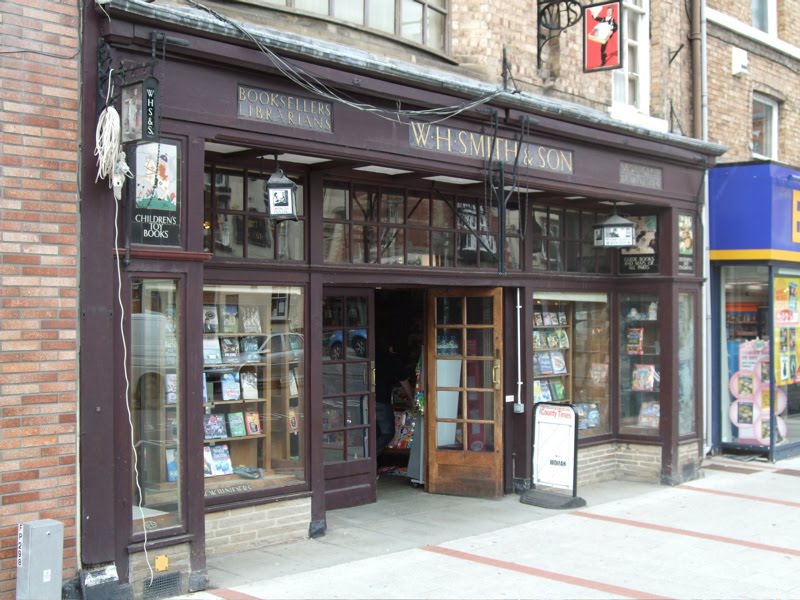
The other photo was of an old W.H.Smith and Son shop. Well, half shop, half museum. The shop was first opened in 1927 and was kept in its original condition when all other WHSmith branches were modernised in the 1970s.

Sunday, 12 December 2010

More dereliction on the Monty


The last two miles along the Montgomery Canal into Newtown sees the canal gradually turning from dry bed to footpath to nothing.


Some of the bridges are in better condition than others.


This scene somehow comes as a surprise. All it needs is water!

Saturday, 11 December 2010

Freestone Lock (derelict)

Freestone Lock, two miles northeast of Newtown, marks the end of the in-water section of the Montgomery Canal.


It's a shame seeing the rubbish in there, but it could be a lot worse. The structure looks sound - a bit of cleaning up and some lock gates and it'd be as good as new. Mind you, there wouldn't be much point using it unless the currently dry canal can be restored to Newtown.


The tail bridge is also somewhat overgrown.

Friday, 10 December 2010

Brymbo iron bridges


Many of the bridges across the Montgomery Canal bear the name "Brymbo". Why? Because the ironwork was made there.


Brymbo is a place in Wales, near Wrecsam (or Wrexham) where John "Iron Mad" Wilkinson set up an ironworks. Production from Blast Furnace No. 1 started in 1796. "No. 1" continued in operation for an astonishing 98 years - what factory building these days could possibly last that long?


All the images above are of the amazing iron bridge at Abermule. It spans both the Montgomery Canal and the River Severn. Over the canal it's a simple girder span, but over the river an elegant arch bears the words "This second iron bridge constructed in the county of Montgomeryshire 1852".


But there are several other Brymbo bridges over the canal. I can't work out which bridge number the above is, but it was built in 1853.


This one (below) is definitely Bridge 153, though. The other side of the bridge the canal dries up and becomes derelict for the last couple of miles to Newtown.


This bridge looks a bit low!

Wednesday, 8 December 2010

Installation of canoe portage points on the Montgomery Canal

Well, I suppose it gets boats of some sort on the Monty. When we walked a good chunk of the Montgomery Canal in the summer we came across a work party busy by a yet-to-be-made-navigable section. The towpath had already been levelled, deweeded and gritted (such a pleasure to cycle along such lengths!), and now a rubber mat was being set into the bank edge. This is to make it easier for canoeists and kayakers to get their craft in and out of the water at this designated portage point.


This was at Brynderwyn Wharf, just north of Brynderwyn Lock.


Seeing the digger so close to the edge is horribly reminiscent of the story BBC Look East told today, of a crane operator whose machine slipped into the Old Bedford River at Mepal. Sadly the crane driver, working for the Environment Agency, was trapped in his cab and died in the icy water.

Monday, 6 December 2010

Piling on the rust

A comment from Mick and Maggie of The Rose of Arden yesterday focussed my thoughts on sheet steel piling, and its susceptibility to rust. I had posted a photo of cows drinking from a section of algae-covered Montgomery Canal between Four Crosses and Vyrnwy Aqueduct which showed what appeared to be rusty piling.

Here's another photo, showing the piling slightly closer up.


As I understand it, rust - ferrous oxide - needs oxygen in order to form. It needs water too, but water without oxygen won't cause rusting. Galvanising steel - coating it with a layer of zinc - protects against rusting, but fixing holes and scratches can expose the steel underneath, which can then rust.


Ordinarily, steel under water low in oxygen shouldn't rust quickly, certainly not as quickly as steel in highly oxygenated water. Perhaps the algae in the photo indicates a high oxygen content, hence the rusting of the piling.

Mick and Maggie wondered whether it might actually have been brown algae, but the way the green algae has sloshed onto the brown makes it look as if it really is rust.

I haven't attempted to go into the electrolytic aspects, but the zinc coating in the galvanising process also acts as a sacrificial anode, in exactly the same way as the lump of magnesium on steel narrowboats' hulls.

In a comment on yesterday's post Martin suggests that the rust is indicative of varying water levels. Fluctuating levels, intermittently wetting the steel and then exposing it to the air, would certainly provide the right conditions for rusting to occur. Add a bit of heat from the sun, and, like putting your wet car into a warm garage, the tin worm is bound to strike.

Sunday, 5 December 2010

Thirsty cows drink the Monty ...


... or are they eating it?


We've already had the sheep drinking the Montgomery Canal.


Back to the cows: see how rusty the piling is. The part which has been above the water looks galvanised. Has something in the water attacked the zinc coating? Or does all piling quickly go like this, only we never normally notice as generally canal water levels remain fairly constant? (Those must be mighty thirsty cows!)

Saturday, 4 December 2010

Mucking about on the Monty


I couldn't resist it. The plump statue was at Buttington Wharf on the Montgomery Canal. The wooden man with a dog was there too. (Look: Sunshine! Shorts!)


The interpretation board suggests that it's David Jones, the lime burner.


Click on the image to read the words.

Nine miles south of here, by Bridge 140, was another statue. Oi! You've got my hat!


I was having so much fun (!) that it was a good half hour of walking along the towpath later before I realised that I'd left my hat on the statue. In full view of the road!


I got straight on my bike, which I'd been pushing while walking with Jan, and whizzed back to see, to my relief, that it was still there.

Thursday, 2 December 2010

No smoking allowed on the Montgomery Canal

Our walk up the Monty from Welshpool on 19th July this year takes us now to Four Crosses and Bridge 100. I like the way the leylandii hedge on the right looks like it's exploding. The effect you get when you freeze-frame a fast zoom.


The wharf building has an interesting cascade of loading doors, one set immediately above the other, but slightly to one side. Was one set of doors an afterthought? If so, which one? Does the change from stone to brick and back to stone give a clue here?


It was only on looking at the photo for this post that I realised that protruding from the roof are the remains of two beams, angled so as to support - I assume - a loading crane.


There is also a "NO SMOKING ALLOWED" sign.


This is similar to one at Queen's Head which I photographed when we cruised there on Shadow in October 2009.


And there's one on the stables at Bunbury Locks on the Shroppie. It's on the very edge of the photo, on the right.


I caught only the "NO"!


I first wondered if these signs were attached to buildings which stored gunpowder. Now, seeing the sign on the stables, I wonder whether the canal company was concerned about flammable materials in general, such as straw, and not merely explosive ones.